Articles
Computational modeling: a new step toward reducing animal testing
Tags: Animal Testing, Research, Alternative Methods, PBPK, Monoclonal Antibodies
Science and animal rights can move in the same direction.
On April 10, 2025, the Food and Drug Administration (FDA), the U.S. agency that regulates drugs and other health products, announced a plan to reduce, refine, and, where possible, replace certain animal tests in drug development. The starting point is monoclonal antibodies, with the aim of gradually extending the approach to other categories of medicines.
This is not a blanket ban on animal testing, nor has the replacement of animal studies already been achieved. But it is a substantial step: a stated commitment to evaluating drug safety using data and models that are more directly relevant to humans.
Why this news matters
For many years, animal testing has been regarded as an almost unavoidable step in preclinical development. Yet one species is not a miniature version of another: metabolism, immune responses, and sensitivity to a substance can vary considerably. This does not automatically make every result obtained from animals useless, but it does call for examining how well different methods predict the outcomes relevant to the scientific question being asked.
In the 2025 announcement, FDA Commissioner Martin A. Makary described the initiative as a “paradigm shift in drug evaluation.”
Finally, rather than pitting animal protection against human health, the goal is to find tools that can improve both.
PBPK: a computational model of the human body
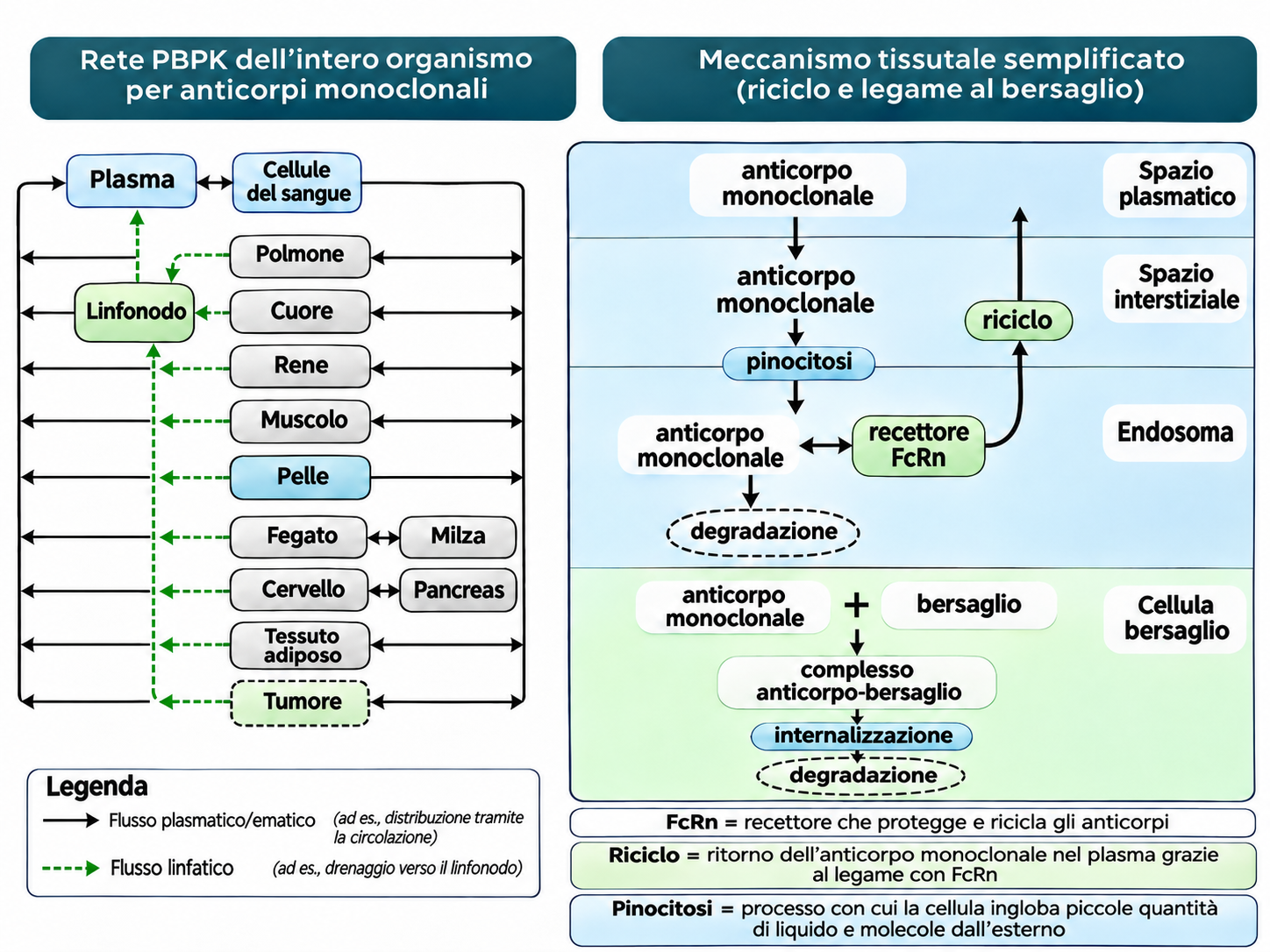
Among the in silico tools particularly relevant to monoclonal antibodies are PBPK models (physiologically based pharmacokinetic models). The idea is to represent the body not as a black box, but as a set of connected compartments: blood, tissues, and the lymphatic system, with volumes, flows, and transport processes described mathematically.
The model combines these physiological data with the drug’s properties to simulate where an antibody goes, at what concentrations, and for how long. This does not mean perfectly reproducing a human being on a computer. It means formulating explicit hypotheses, quantifying them, and checking how well the data support them.
Why monoclonal antibodies are a special case
Monoclonal antibodies are large proteins. Unlike many small-molecule drugs, they do not readily cross cell membranes, and their distribution also depends on movement from blood vessels into tissues and return through the lymphatic system. Their elimination is not primarily governed by the same metabolic processes typically associated with small molecules.
For many antibodies of the IgG class, the FcRn receptor also plays an important role: after an antibody is internalized by a cell, this receptor can protect it from degradation and help return it to circulation. This is one of the mechanisms that contribute to the long persistence of many therapeutic antibodies in the body. PBPK models can explicitly represent these processes.
Another factor is target binding. If an antibody encounters the antigen it is designed to recognize, binding and subsequent internalization or elimination can alter its pharmacokinetics. This is known as target-mediated drug disposition (TMDD): behavior that, in some cases, means the drug’s effect does not increase in direct proportion to the dose.
Integrating PBPK and TMDD helps researchers study these dynamics without treating the body as a simple statistical average.
What can we predict, and what are the limitations?
A suitably constructed model can help explore distribution across tissues, changes in concentrations over time, different dosing regimens, and the effects of physiological parameters or antibody properties. It is also a way to make uncertainties transparent: which data are known, which are estimated, and which predictions change when the assumptions are modified?
These tools do not automatically replace every safety study. A pharmacokinetic prediction alone does not demonstrate the absence of adverse effects or unwanted immune responses. Reliable experimental data, comparisons with independent observations, and validation appropriate to the intended use are essential. Artificial intelligence can contribute to data analysis, but PBPK is not synonymous with AI: the core of the method is a mechanistic description of physiological processes.
In its 2025 announcement, the FDA specifically mentioned the possibility of using computer simulations to model how a monoclonal antibody is distributed throughout the human body.
What happened in 2026?
On December 2, 2025, the FDA published draft guidance identifying specific circumstances in which six-month toxicology studies in non-human primates could be reduced or eliminated for certain monoclonal antibodies.
On April 20, 2026, one year after its initial roadmap, the FDA published an update on early progress and cited that draft guidance among the milestones achieved. This is an important development, but it does not amount to a general, already completed elimination of animal testing. Decisions still depend on the specific product, the quality of the available evidence, and the regulatory authority’s assessment.
A scientific reason and an ethical reason
The question should not only be, “How can we eliminate an animal experiment?” but also, “How can we obtain better information while causing as little suffering as possible?”
This news means that the premise has now been accepted at every level: animal suffering cannot be regarded as an invisible cost of research.
We must invest ever more in alternatives to animal testing, in the hope—still a distant one today—of one day abolishing it altogether.
The most promising change is not a single technology: it is the shared idea that more accurate research can also become more responsible research.
Sources and further reading
- FDA, April 10, 2025 announcement: plan to reduce reliance on animal testing.
- FDA, 2025 roadmap for preclinical safety (PDF).
- FDA, December 2, 2025 draft guidance on non-human primates and monoclonal antibodies.
- FDA, April 20, 2026 update on first-year goals.
- FDA, 2026 report on the first year and next steps (PDF).
- Glassman and Balthasar, review of PBPK models for monoclonal antibodies.
- Jones and colleagues, prediction of antibody pharmacokinetics from in vitro data using a PBPK model.
- Diagram adapted from https://link.springer.com/article/10.1007/s10928-011-9232-2.
Last updated: November 17, 2026.